Wednesday, 3 September 2014

Äspet sunrise at 6.09 AM


 ÄSPET EARLY MORNING AT SUNRISE


First shed of sunlight over the horizon.


The golden hours are important fort photographers because of the exclusive light conditions early mornings or late evenings. This time I reached Äspet, south of Åhus half an hour before sunrise, chose the right place from earlier visits and set up the camera. While waiting for the sun to appear there is enough light to capture scenes like the one above; some mist and clouds far away and first sunstrokes appearing above the horizon. The following pictures will take you through the sunrise moment by moment.

But before that briefly on Äspet. Äspet is a nature reserve with beaches, large sand-hills, forest and a lagoon where many bird species thrive luring birdwatchers during high seasons. To find it drive south on route 118, cross Helge river and then turn right towards Äspet following the river bank. A good parking place is close to the bird watching towers. 


The other bird tower at some distance.


North-easterly direction with the bird lagoon partly visible on the left.


My APP "LightTrac" informed about the time, 6.09 AM in this case, and direction for the sunrise. It is good to be on time because the speed of the sun rising is surprisingly fast and camera settings are ideally set beforehand.


First moments. Sun rising next to the bird watching tower.

The sun moves rapidly and gets brighter changing the light conditions.

Flare on the lens suggest light conditions are getting too intense.

 It is then time to move to another position because the show is not over yet. The next 30 minutes or so offer new angles and opportunities including shadows and "golden" moments like in the below two pictures. But the sun is still moving fast and every moment is critical. The tree comes handy allowing to play with the light a bit longer.


Further along the path the bird tower is still visible but the scene looks different.


The sunlight is very strong and best hidden behind the tree.

At this point the best opportunities are used and it is time to head back home. Mrs. T is waiting for a lift to work at 7.45 AM latest. Walking towards the car still offer a few photographic opportunities: Bulls grazing next to the bird tower that, who knows, might get handy for other reasons, too.


Breakfast time!


A second bird watching tower closer to Helge river and the harbor area of Åhus.


Factories in the Åhus harbor area already busy at this time.

I have now reached the car and head for home. Good, just enough petrol to take me home. Or so I thought. Having driven two-thirds of the distance the meter for petrol suddenly indicated ZERO - or not even zero but only "------"  WELL NOW, what should one do? Find the closest petrol station and risk that one runs out of petrol anyway OR continue towards home destination where there is a petrol station for sure. I chose the second alternative and kept my fingers crossed. Crossing fingers helps - I MADE IT and MRs. T got to her job on time. 

Hope you liked this little excursion. At least you did not get up early to experience it.

KEEP YOUR FINGERS CROSSED!


:-)


Monday, 1 September 2014

The Black Hills


Svarta Bergen or The BLACK HILLS


Old winching house by the quarry.


This old quarry is situated in our neighborhood or 4 km's from Lönsboda in north-eastern Skåne. This old quarry was started in 1899 and was important for the region that suffered from emigration in those days. The diabase stone, or black granite, from this quarry has been supplied e.g. to Sweden, USA (e.g. The Empire State Building) and Italy. This quarry was closed down in 1989 and is now preserved as an open-air museum that shows the working life in this industry in the old days. It is marketed for relaxation and inspiration, school classes and groups, art-lovers and photographers. By pushing a button in selected places you will hear a loudspeaker above your head telling stories and giving information.


Krutgubbarna or the "Gunpowder Guys" welcome you at the gate.

The quarry is 900 metres long, 50 metres wide and 92 metres deep but now full of water. Everyday workers had to climb down some 200 steps and back up again. Sixteen cranes lifted up stone material with a maximum weight of 12 tons. The thing was that in the early days workmen had no means of checking the weight of the stones to be lifted up. Despite extra carefulness I believe that there where some accidents. Diabase is still shipped from the new quarry and the stone is used for many purposes including sculptures, works of art, jewelry, facades etc. The veins of the diabase are roughly 1000 million years old and developed as a result of volcanic activity when magma rapidly cooled down. 


Cranes and crane sheds along the quarry.


The men worked down in the quarry all year around. The one handling the cranes in the small sheds were lucky to have a fire place to keep themselves warm. Working teams consisted of two-three men that worked the stone by hand. It took them 10 hours (one working day) to prepare a 3 metres long narrow hole where  the gunpowder was measured and ignited. The area was opened in 1994 as a tourist site making it possible to visit this exciting and unique place in a beautiful natural setting. Several sculptures has been erected by local and international artists.


Black Hill quarry transfered into an open-air museum.


The stone piles above formed an airborne rail system for stone material that were scrapped and piled nearby. It is easy to walk along the many paths in the restricted area, all with signs guiding your way. You will see many sculptures along the route and can read the stories of these art works made of stone. In the red coffee house open all days except Mondays summertime. They display a photographic exhibition and also sell jewelry and smaller pieces of art work.


A selection of sculptures at the Black Hills Quarry.

The vertical work is named "Pyramide with a displaced apex" signed by the artist Takashi Naraha. It reminds us of the life cycle where the displaced apex "symbolizes the fact that life does not always behave as we human beings expect it to; it will not always evolve in a straight linear fashion." Again, the suitcase is named "Good-bye and Thanks" as the artist Masaru Takahashi's appreciation of the black diabase that he wanted to take with him home. 

My visit to this quarry was short but very interesting. The site has successfully been transfered into an exciting tourist attraction worthwhile a visit if anyone passes the region. The entrance fee is SEK 30 that I still need to pay for (shop is closed on Mondays) when I next time visit them. By the way wheel chairs have good access but this is the first place I have encountered where picnicking is not allowed. And also, be mindful of the steep quarry sides. 


Signs guide you around the area from site to site.


Hope that you have liked this visit to the SVARTA BERGEN QUARRY as much as I did. Have a good week everyone and take care.


:-)


Thursday, 28 August 2014

An Awesome Air Show


Air Show at
KRISTIANSTAD ÖSTERLEN AIRPORT


Boeing Stearman Primary trainer in US,  used later a Pratt &Whitney engine.

When Mr. T Jr. made a point that a visit to an air show would be interesting I was not sure what to expect as I had not been to one before. The Kristianstad air show gave me an opportunity to fill in this gap and I got there early enough before the airborne part of the show started. At the end of the day I was excited about the event that offered a sky full of different planes each with their slot for presenting their machines, pilots and flight programs. The highlights were when Spitfire and Hawker Hurricane shared the same air space in Sweden for the first time and when the Hawker Hurricane was introduced in Finnish retro colors to commemorate the Finnish Winter War and flew with Sibelius sounding from the ground speakers. WHAT A FANTASTIC MOMENT! The other highlight came at the end when Jas 39 GRIPEN entered and performed a stunning program of its own flying low. How these pilots master a fast flying plane like this is fantastic.


Hawker Hurricane and Spitfire helped win the Battle of Britain in the 2nd World War.


Hawker Hurricane performing. Not many of them left anymore.


Spitfire airborne and on the ground. Every pilots dream to fly this machine.


The slots given to each flying machine was 30 minutes and once one program was finished another started so there was not a dull moment during the whole day. But a personal slot for "pölsemannen" or a sausage was necessary. Also parachuters had their own slot and these "dare devils" landed just in front of us. They came down very fast but where able to hold up only seconds before landing. Another interesting thing was the model airplanes that indeed are no toys but rather large flying machines that can get up to very high speeds and perform similar aerobatics in the air as their big brothers. 


Another interesting airplane was the US built Pitts Special originally design by Curtis Pitts in the 40´s  as an aerobatic biplane. This single-seated machine still competes successfully. It has a 200 hp flat-4 Lycoming engine but some versions carry a 450 hp machine (Wikipedia).


Pitts Special - a beautiful machine with a short wingspan perform stunningly.

Pitts Special in its aerobatic performance over Kristianstad Österlen airport.


Another interesting flying machine is the Boeing-Stearman, another bi-plane used for military practicing since 1930's. After the second World War many were sold to civilians as crop dusters, sports planes and for wing-walking and aerobatic use in air shows (Wikipedia). A popular modification has been installing a Pratt & Whitney R-985 engine to improve take off and climb performances.


Boeing-Stearman.


And yet another World War II "veteran", the North American T-6 Texan (below) a single engined trainer aircraft for USAAF and the US Navy as well as the Royal Air Force until the 70's but also used in combat use by many countries (Wikipedia). Lately this aircraft has been used in air shows and movies like "Tora ToraTora", "The Final Countdown" and "A Bridge Too Far".


T-6 Texan performing.


Crowds watching the show and parachuters dropping down in high speed. 


Finally a series of the Soviet built Yakovlev Yak-55, a single seated aerobatic aircraft that has won many championships - the first in 1984 by the Russian aerobatic team. It has a 360 hp Vedeneyev M14P engine driving a two-bladed propeller (Wikipedia).


Yak 55


Two Yak's competing each other in aerobatics with Per Norén coming out as the winner.


Other flying machines appearing at the show includes e.g. a Laser, two helicopters and a glider that was self propellered needing no pulling help. The "Seawind" below did not fly.


Participants in the Kristianstad Air Show.


The second highlight of the Air Show came last; Jas 39 GRIPEN appeared from the skies with a roar that kept everything else silent. This modern fourth generation multirole fighter aircraft is designed for fighter, attack and reconnaissance missions. It serves in the Swedish Air Force and in some other countries, too. It is powered by Volvo engines and reaches a top speed of Mach 2, or 2448 km/h in a temperature of +15 degrees.


Jas 39 GRIPEN


This fantastic day was over very quickly and it remains only to extend an appreciation to the organizers Kristianstads Flygklubb (Aeroclub) for an event not easily forgotten. Much appreciation also to the speaker on the ground that kept us all very well informed of what was going on and also knew to explain correctly the retro colors of the Finnish Hawker Hurricane.


Have a nice up-coming weekend everyone.


:-)


Saturday, 23 August 2014

Ballingstorp, Östra Göinge


BALLINGSTORP, Östra Göinge


Ballingstorp inner garden


We have several times paid attention to a road sign along route 19 on our way home saying "Ballingstorp 2" and a few times wanted to pay a visit to this old croft originally mentioned in the 16th century. Today we decided to visit the site and found a fantastic, cosy milieu two kilometers from the main road. The site was donated by the last farmer in 1953 to the local authorities that are preserving the place in its original condition. Unfortunately we could not enter the buildings but the surroundings gives plenty of interesting work for a photographer. 


A narrow path from the inner garden out to the fields.


The croft was leased to local farmers and the first farmer in 1532 was Trued Jennssön who provided the landlord with crop, firewood, peat and labour as rent. Bee-keeping, fishing and gardening were also important for the household. The present buildings, typical for this area, are mainly built in 18th and 19th centuries but part of the building timber is dated to the 17th century. 


Entry to Ballingstorp.


This croft site is rather big and offer plenty of details to photograph from different angles. We stayed about two hours on a sunny day. Mrs. T pointed out that there are two large tables and benches available for picnickers in these peaceful premises and this place is not far from us. She also tried out the pump for the well, without luck though.


View of the backside of the main building.


Above information is derived from www.lansstyrelsen.se and www.skaneshembygdsförbund.se and there is much more available e.g. about the construction technique and living in this croft over the centuries. A really beautiful site it is and something of a hidden gem.


Details of the croft and Mrs T investigating the situation with the well.


View from the road over the stone fence.


Thank you for sharing our interest in this wonderful site. The final picture is taken from the inner garden and reminds us that there are still summer days left before we enter the fall. If you visit the place you may be as lucky as Mrs. T to spot an eagle (kungsörn in tho case) close up. Unfortunately my camera was focussed on something else at that moment. 


Ballingstorp 23rd August, 2014. 


Tomorrow is the day for the AIR SHOW at Kristianstads airport. Weather forecast is promising acceptable photographing conditions so we hope to be back soon. Meanwhile, enjoy your week-end.


:-)


Thursday, 7 August 2014

Villands VÅNGA


In the surroundings of Villands Vånga


An old stone fence in the forests of Lerjevallen.


Up to now we have been very busy moving around Skåne getting to understand the differences in the regions and their activities. This time we are moving into a different world, away from mass tourism, in the Skåne wilderness near Vånga. A tip from Mrs. T made me look into what would be available in this region. Vånga itself is a small village in the Kristianstad municipality, beautifully located near Lake Ivo. The area is particularly well suited for growing fruits and berries but my attention was this time caught by two unusual sites nearby Vånga. They both have their own story to tell that might interest our readers, too. In the early 20th century, near Lake Lerje, existed a village called Spångabro that has since then disappeared and is now called the "The Dead Village". What happened to this village? The other site is a ravine called Kastagropen that is said to have a background with the so called snapphane-people during the Swedish-Danish wars in the 17th century. Both sites proved difficult to find as I had to rely on map-details (no road signs) and advice from local people as to the directions. Having said that, Skåneleden will carry you from Lake Lerje to Kastagropen if you are open for a physical challenge.


Lake Lerje and Lerjevallen with Spångabro


Lake Lerje and its surroundings.


Lake Lerje is a small lake in north eastern Skåne where Lerjevallen offer outdoor activities both winter and summer time. Cottages can be rented through Kristianstad municipality. On the northern slopes, among thick forest, existed the village of Spångabro. The remnants of the village is trusted to an organisation that now organize walks amidst the ruins of the village. Today I was on my own with an old map drawn by Rickard Nilsson showing the approximate position of the houses. Unfortunately all I could see was some old stone fences (see above). Where the village (consisting of some 40 buildings) had been, the forest have grown thick and a guide is most useful in order to find your way to the buildings or what is left of them. Seems that the village was desserted because making a livelihood become more or less impossible. People lived in simple dwellings built by their own hands, worked hard for their living and often had to walk long distances to carry out their duties and sometimes all the way to the city of Kristianstad.  "Väva-Anna" did weave all her life, "Stava-Per" was the tailor and "Örn-Ola" the butcher. People worked as laborers in the nearby farms. "Löne-Sven" once walked tired home and had to have a rest walking uphills. The story says that he fell asleep "but woke up early enough to make his way to work next morning". These stories and more have been written by Rickard Nilsson and published in Kristianstadsbladet 17th November, 1960. 


An overnight resting place along Skåneleden at Lake Lerje.


I followed Skåneleden a short distance but as it was about 6 km to Kastagropen, and 15 km to the next resting place, I decided to return to the car and drive there via Vånga. 


Kastagropen 


Advice to new visitors. Follow the road to the tree line and look left. 


My first attempt to reach Kastagropen failed as the road I had taken thinned out to become a narrow path and then soon finished in a dead end. The road was the correct one, but the ravine of Kastagropen was nowhere to be seen. Best to return to the village and ask for advice! I was kindly offered another more detailed map and the route was verified. The advice was: "Park the car at the end of the path and walk the last bit". The above pictures offer a view of the area where one has to abandon the car (behind the bushes). There is enough space for a small car to turn around for the return trip. The electric lines make a good landmark and are marked on the map, too. Then move through the bushes and look left for a narrow road (guides say it's from medieval times) that runs through the ravine. If you, like I, take the wrong turn you may end up facing a "wall" of birch trees - do not try to penetrate but return the same way to the main road. Follow it and keep your eyes on the left hand side where the ravine soon will appear. Another piece of advice: If you do as I did (left the car door open for some time) you will get a herd of flies in your car. Not recommended!


WHAT IS Kastagropen? It is a ravine in a beech forest. During the rainy season a stream runs through the valley but summer time it dries out. WHAT IS a Snapphane? This is the name of a person (bandits, laborers or forces) that counteracted on Swedish groups during the Swedish-Danish wars in the 17th century. Most of  them lived in Skåne that belonged to Denmark for 600 years. The reasons for counteracting on the Swedes are many and different Snapphane groups operated in different ways for different reasons. All in all the Swedish government regarded them something of soldiers of guerrilla war fare and executed many to set an example. Stories tell that some where hanged in KASTAGROPEN. For me this ravine with its dense forest offered a fantastic playground for practicing my camera on light and shadows and offer different kind of photographs - some of which are best in black&white or sepia. 


Tried as B&W but best in natural colors.

This one in sepia.

General view in B&W.

Dry season!

Light early in the day.

Light conditions in late afternoon.

Plenty of interesting details.


An entirely different world, isn't it? And still only a short drive from main cities and airports. Plenty of photographic angles to discover - while sitting on tree stump consuming an afternoon snack. Well, I wanted to try to find an abandoned village and saw at least stone fences. On the way back to pick up Mrs. T from work I passed an abandoned house that was just the perfect target for an HDR photo (below). Makes interesting pictures, HDR.


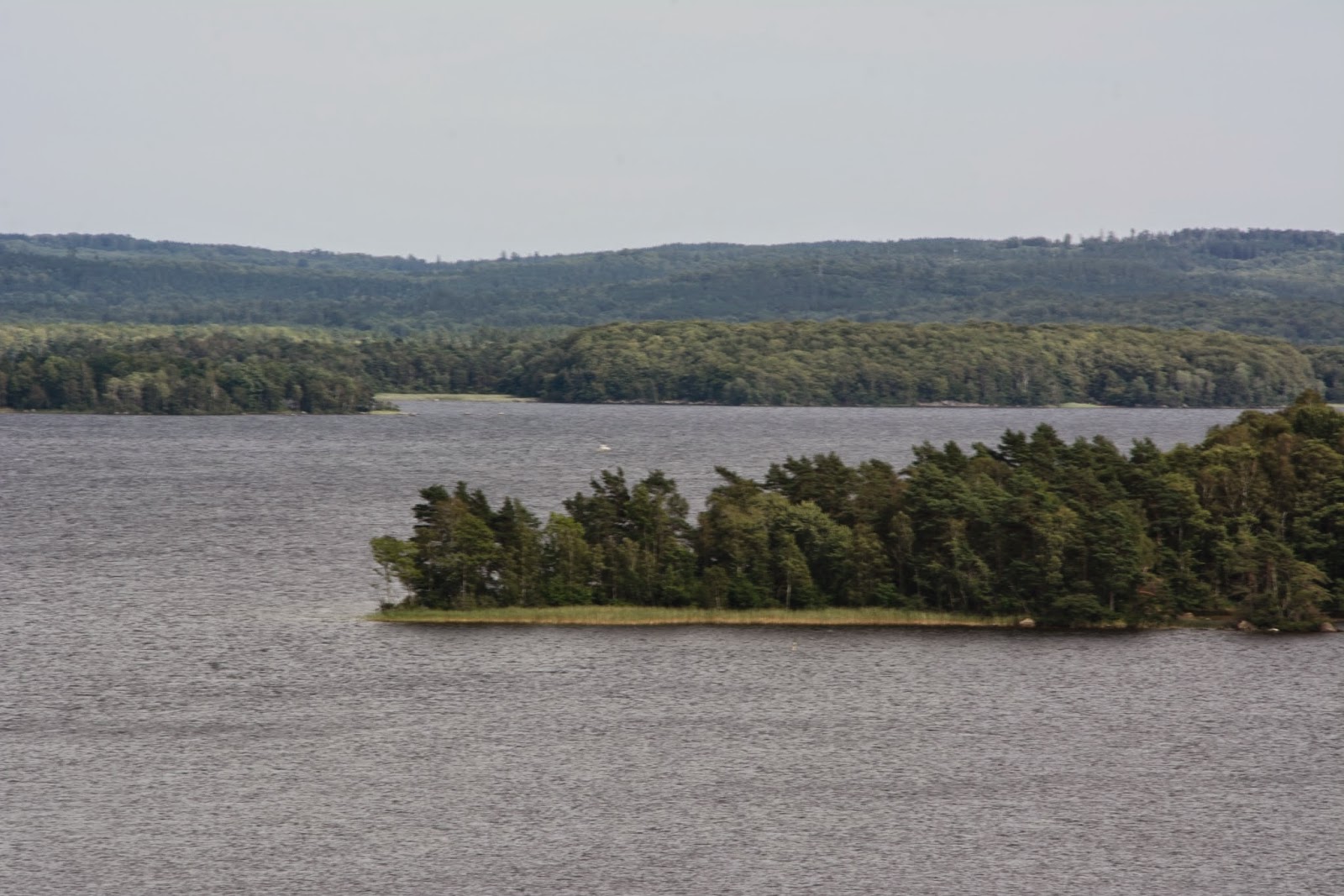
And a final view over Lake Ivo before leaving the area.


An interesting and a DIFFERENT day out today. How do you like the pictures? Hope you all have a great week-end coming up!


:-)