Friday, 26 September 2014

Royal Guests at Wanås


Wanås Castle, Östra Göinge


Pictures taken over three days in connection with the visit from the Swedish Royal Family.


Overlooking the castle across the pond.

Wanås Castle is situated in the green northeastern Skåne where wonderful beech forests light up the environment. Situated on the historic border between Denmark and Sweden it has a background as "Snapphane-region" in the 17th century. Today Wanås Castle is privately owned and on the grounds operate both Wanås estate and Wanås Art. Wanås Estate AB is active in forestry and agriculture, hunting and property management (www.wanas.se). Wanås Art display some 50 permanent works in the park with new entries from national and international artists annually. For more information visit our earlier blogpost or the Wanås website.


Left Wanås Art entrance and its exhibition halls and Wanås Estate in the background. 


HM Crown princess Victoria and HM Prince Daniel

On a full day visit, by invitation of the Göinge Trade and Industry, to Östra Göinge and Wanås.


Attentive of the Art Collection in the beech forest.

Living very close to Wanås gives us the opportunity to visit the premises often for walks and photographic purposes. The exhibitions are interesting and the park, including the art work, beautiful to visit for an afternoon stroll. Earlier in the summer King Carl XVI Gustaf and Queen Silvia visited Kristianstad and now we had the opportunity to join the locals in welcoming Crown princess Victoria and Prins Daniel. 

I arrived early enough at Wanås and entered with my fresh Season Card. Then spotted the waiting crowd and joined them. With my camera I am often mistaken for "The Press" so also this time, but I know to excuse myself as "The Public". This actually gives some advantages as I then can move freely and not being ushered in a strict manner like The Press has to cope with. Moving freely, with some polite guidance from "The Security" allows me to find good positions for photography like the picture above and the two below.


A Welcome Flower.

The draw back can be that I may have difficulties knowing what way the guests are going to take and running alongside is not always possible. I may therefore find myself in the rear of the procession and overtaking it can be cumbersome. Below,  by "The Wish Tree for Wanås" by Yoko Ono, we are doing just fine. Later in the woods I made a circumventive move in order to join "The Press". I found the perfect spot for myself but was soon surrounded by "The Press" and cameras where going off all over the place. I was asked who I was - ahaa, "The Public". Later I understood not to enter the Private areas of the Castle but instead let the professionals do their work.


By the "Wish Tree for Wanås" by Yoko Ono.


Forest Surrounding Wanås

A few shots from the forests around Wanås. The below mushrooms caught my attention as they were way up on the tree. The below collage give some understanding of the colorful beech forest and the art works displayed there. The tree in the middle is called the Snapphane Oak that is about 500 years old. It played a role during the Snapphane Rebellion during the Swedish-Danish wars in the 17th century as some rebells are said to be hanged by their neck from this tree.


Mushrooming 10 meters up.


Wanås Beech Forest and the Snapphane Oak in the middle.


Wanås Art

Wanås is marketed as the place where "art, nature and history meet" and this is perfectly true. Mrs. T says that she (that means "we") have never seen anything like this before. From contemporary art Wanås has also moved into other visual arts like design, dance and architecture. They also publish books, organize seminars and activate thousands of children for educational purposes (www.wanas.se). Much attention is given to create an international profile for Wanås Art. A short presentation of only a few of all 50 permanent art works.


Embraced by Nature


Presenting Wanås Art; Left "Wish Trees for Wanås" by Yoko Ono, top right "Two Different Anamorphic Surfaces" by Dan Graham and right middle "Whitney Outhouse of American Art" by Thom Merrick.


Wanås Art; left "Wanås" by Per Kirkeby and right "Primary Structure" by Jacob Dahlgren.


Spring 2014

Our first visit to Wanås took place in the spring of 2014 when we had moved to Östra Göinge. The below picture is unique in the sense that it no longer "exist" because of a sculpture placed here. The second picture reminds us of the fact that Wanås is very much also for the children.


Resting place by the pond early spring. 

A Childrens Wanås, too.


Mrs. T and I hope that our readers find Wanås as intriguing as we do. The season is ending in October with opening hours during week-ends only. The "Sale" in their shop is on by the way. And they are organizing a photographic competition - quess who is participating?


Have a very good week-end and join us for Kivik Harvest Festival tomorrow, Saturday 27th.


:-)


Monday, 22 September 2014

Swedish Hand Loom Museum


Hand Loom Museum, Glimåkra


This museum for hand looms is situated in northeastern Skåne and it is run by a non-profit organisation. It has a permanent exhibition of looms and tools and in addition it offer 8-10 changing exhibitions in textile art and traditional crafts annually. Also lectures are held and small educational groups get together weekly.  Weaving courses are organized e.g. for rags, carpets, clothing fabrics, towels, placemates etc. Approximately 6000 visitors attend the annual Weaving Days that this year is held 23rd-25th October.


Museum exhibition hall.


Mrs T is a lucky owner of a hand loom so this visit to the museum in order to get information and hints for the future. Ingrid Svensson, who looked after the museum this day, was kind enough to show us around the exhibition and also explain about production of linen. The exhibition displayed unbelievably pretty products that had required considerable time and effort to finish.


Mrs T walking through the exhibition.


Exhibition segments


Hand Looms and Tools


A smaller loom for the production of runners.


Ingrid showed us small and large looms from different ages. They have not changed much over time and considerable effort from two or three persons is needed to set up one for productive work. A smaller rag would thereafter take about one day to produce.  Also very thin and translucent works like curtains can be manufactured which delighted Mrs. T who anyway understood the limitations of a beginner. Anyone new in this profession can take part in one of the many courses organized within the premises (info@vavmuseum.se).


Different hand looms of the museum.


Mrs T preparing her hand loom.


The Swedish Loom Museum is a very well kept professional facility in a nice surrounding in the town of Glimåkra. They offer excellent services for anyone interested in handicrafts and the annual Weaving Days is an international happening. For details visit their website www.vavmuseum.se  


Thank you Ingrid for your kind and professional introduction. Mrs T wishes a nice and productive week to everyone.


:-)


Monday, 15 September 2014

Oppmanna - Vånga Harvest Festival


Vånga Harvest Festival 2014


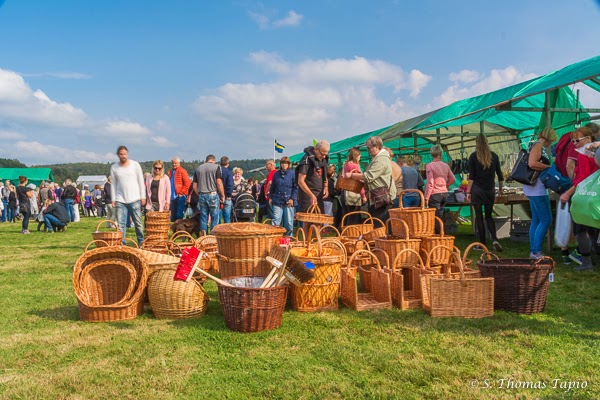
Fruits, vegetables, handicraft and much more was offered at Oppmanna-Vånga Harvest Festival 2014.


The Oppmanna-Vånga Harvest festival is organized annually in September to celebrate the year's harvest. Mrs. T booked early this day for an excursion as the region is famous for its fruits and vegetables and she wanted to have her share of both raw materials as well as the refined products at offer. We arrived among 3500 other visitors to discover what almost 70 market stalls had put on display (see also www.vangabacken.com/skordefest). Many seemed to know what they where looking for and traffic on the parking lot was busy as cars where continuously coming and going. We took two tours around the stalls, talked to some people and then returned home via lake Ivö. Our "catch" is presented in the last picture.


RAWMATERIALS

The APPLE season is here. Could this be AROMA?

Apples have been cultivated in the Vånga region since medieval times when the monks from Bäckaskog monastery initiated the idea (Borglund Linn 2014; Grönhults fruktodling i Vångabygden).  The orchard of Grönhult, one of the oldest in the region, carry some 35 different varieties. We purchased "Discovery" and Mrs. T praised this to heaven. 


Market stalls with fruits and vegetables.


Apples, plums, pears, raspberries, carrots, leaks ...endlessly.


Rawmaterials where in abundance. It was only the raspberries that disappeared into customers bags before I had any chance of even photographing them, let alone purchase. The size of all the fruits amazed us as in native Finland we do not recall having seen such large and juicy product. When we reached the car on our way home we tried the plums - could not resist - size, juiciness and taste were of top class. 


PROCESSED PRODUCT


Stalls form long rows forming a square on this field.


Processed product from the sea and the fields.

"Vånga 77.1" is a blooming business that run conferense, restaurant and bakery services. They also produce their own beer made of birch sap, different marmalades and apple juice. "Vånga Must" also offer ecological apple juice made of a variety of fruits including the provincial apple AROMA that was introduced in the 70's as a hybrid cross of "Ingrid Marie" and "Filippa".  Åhus Sylt och Bär purchase sea buckthorn berries from different places in Sweden, including Öland, and makes a juice rich in vitamins and especially omega-acids beneficial against inflammations and gastrointestinal disorders but is also recommended for improved blood circulation. We now take a sip every morning of this "elixir".  The gentleman from Näsums Laxrökeri said that eel has been in abundance this year due to suitable conditions out in the sea that has brought the fish to the eastern coast of Skåne. This eel was smoked the day before, and I can only regret that we had run out of cash at this point.


HANDICRAFT AND OTHER PRODUCTS


Well-designed baskets.


Professional design and manufacture at all stalls.

One could have spent a small fortune running through all the stalls. Mrs. T talked to the lady selling "Luffarslöjd" or small household produce made of metal wire. Bending the wire is an arduous and heavy task to carry out and fingers easily get twisted. Great homemade marmalade (tasted some), unusual metal work enameled in a colorful way and many well designed handicrafts exchanged ownership. Mrs T, a proud owner of a hand loom is discussing the manufacture with a specialist, below.


Mrs. T discussing home made rags.


Some senior gentlemen had brought their own and well kept motorcycles for the audience to admire. One was an old Swedish made Husqvarna from 1933 and the other a British AJS made by Hercules in the -50's. They are used every week according to the proud owners.


Maybe not the fastest, but steady.


Äppelriket sorts, packes and distributes apples from 94 farmers in southern Sweden.


With the above commercial presentation of Äppelriket we now leave the Festival area, jump in the car to drive back home via lake Ivö, as usually. This time conditions provide for slightly better pictures.


Lake Ivö viewed from the main road.

And after Ivö we spotted more "fruit" on the right hand side of the road - giant pumpkins, a field full of them. Had to get a few shots of them, too.


We soon arrived at home to display our own "harvest" from Vånga, below.


"Candies" of the soil.


I know that you wanted to be there, too. Vånga Harvest Festival was a high class act, well organized with fresh and high quality (home made) products. No wonder this small village attract thousands of visitors each year. But it is not all over yet. Why not join the Kivik market in Österlen end of September. This is going to be big!


Have a very nice week everyone!


:-)


Saturday, 13 September 2014

Autumn colors at Simontorp


Simontorp in September


View from route 119.

It is early autumn when I head for Simontorp that I have earlier observed from route 119 when driving past it. This small village nowadays consists of 7-8 households and some free-time villas. In the past the village had their own smithy to produce scythes and a saw to produce planks. The smithy no longer  exist but a saw still works and the old site is now turned into a touristic attraction allowing us to make cultural strolls in the neighbourhood. For more information see www.simontorpkonsult.se 


Entrance to the old saw with a museum and remnants of old crofter's holdings.


The organizers inform that Simontorp got its name in the year 1200 and was owned by Erich Geet who belonged to the royal council of Skåne. Later the yard belonged to Bosjö Abbey for a longer time and in 1803 the ownership was transfered to the present family. 

Simontorp konsult provide maps and general information at the entrance (for a nominal fee) for visitors allowing them to make their own way. There are several cultural paths to choose from and colored signs indicate the right path to follow. Sites are indicated by numbers matching the information sheet that provide general information about the area and its attractions.


My first encounter is the old stone bridge. Earlier crossing the narrow stream was possible only by wading. When the Swedish-Danish war erupted in the 17th century a wooden oak bridge was constructed later to be replaced by the stone bridge (Simontorp Konsult). The road was called the "The Priest Road" because the same priest served in two communities on separate sides of the stream.


Stone bridge crossing Simontorp river.


The next encounter is with the museum in the red shed displaying old agricultural tools. All with detailed description of what any specific tool was used for. Below sledges to transport timber during the winter and a wooden harrow for smoothing out the fields. Immediately next to the museum is the water driven old saw that had its heydays in the 19th century. The price for running a log through the saw was 0,14 crowns.


The old saw and the agricultural museum.


In the immediate vicinity of the saw some remnants of former crofts can be detected. The stone fence below is what is visible of Nils Bordins croft. He was allowed to cultivate the grounds and keep three sheep and one pig. He was also a smith and therefore useful for the saw. Nils and his wife Kersti had two children and both parents reach more than 80 years of age. The other croft with a stone wall visible belonged to several crofter starting with Per Svensson in 1772. Diseases like tuberculosis and colic had its toll among the crofters.


Crofts of Nils Bordin and Per Svensson.


Simontorp is surrounded with woods and the nature provide for enjoyable strolls. This day was warm and the few rain showers refreshed the air bringing the scent from the green forest to ones nostrils. It is mushroom time so a few close ups of the "fruits of the season". 


The colorful autumn is here.


It was interesting the see this small village and learn to know some of its former inhabitants and their way of living. With some imagination you can remove the new main road from the scene and also remove the tarmac from the old road to get the old picture 150 years back in time. An idea would be to remove the soil around the crofts and the old charcoal stacks to make the picture complete.


Thank you for following us to Simontorp. For the information above courtesy is given to Simontorp Konsult AB. The autumn is here so harvesting time will next take us to markets and festivities in Vånga and Kivik famous for their fruits.

Enjoy your week-end


:-)


Wednesday, 3 September 2014

Äspet sunrise at 6.09 AM


 ÄSPET EARLY MORNING AT SUNRISE


First shed of sunlight over the horizon.


The golden hours are important fort photographers because of the exclusive light conditions early mornings or late evenings. This time I reached Äspet, south of Åhus half an hour before sunrise, chose the right place from earlier visits and set up the camera. While waiting for the sun to appear there is enough light to capture scenes like the one above; some mist and clouds far away and first sunstrokes appearing above the horizon. The following pictures will take you through the sunrise moment by moment.

But before that briefly on Äspet. Äspet is a nature reserve with beaches, large sand-hills, forest and a lagoon where many bird species thrive luring birdwatchers during high seasons. To find it drive south on route 118, cross Helge river and then turn right towards Äspet following the river bank. A good parking place is close to the bird watching towers. 


The other bird tower at some distance.


North-easterly direction with the bird lagoon partly visible on the left.


My APP "LightTrac" informed about the time, 6.09 AM in this case, and direction for the sunrise. It is good to be on time because the speed of the sun rising is surprisingly fast and camera settings are ideally set beforehand.


First moments. Sun rising next to the bird watching tower.

The sun moves rapidly and gets brighter changing the light conditions.

Flare on the lens suggest light conditions are getting too intense.

 It is then time to move to another position because the show is not over yet. The next 30 minutes or so offer new angles and opportunities including shadows and "golden" moments like in the below two pictures. But the sun is still moving fast and every moment is critical. The tree comes handy allowing to play with the light a bit longer.


Further along the path the bird tower is still visible but the scene looks different.


The sunlight is very strong and best hidden behind the tree.

At this point the best opportunities are used and it is time to head back home. Mrs. T is waiting for a lift to work at 7.45 AM latest. Walking towards the car still offer a few photographic opportunities: Bulls grazing next to the bird tower that, who knows, might get handy for other reasons, too.


Breakfast time!


A second bird watching tower closer to Helge river and the harbor area of Åhus.


Factories in the Åhus harbor area already busy at this time.

I have now reached the car and head for home. Good, just enough petrol to take me home. Or so I thought. Having driven two-thirds of the distance the meter for petrol suddenly indicated ZERO - or not even zero but only "------"  WELL NOW, what should one do? Find the closest petrol station and risk that one runs out of petrol anyway OR continue towards home destination where there is a petrol station for sure. I chose the second alternative and kept my fingers crossed. Crossing fingers helps - I MADE IT and MRs. T got to her job on time. 

Hope you liked this little excursion. At least you did not get up early to experience it.

KEEP YOUR FINGERS CROSSED!


:-)


Monday, 1 September 2014

The Black Hills


Svarta Bergen or The BLACK HILLS


Old winching house by the quarry.


This old quarry is situated in our neighborhood or 4 km's from Lönsboda in north-eastern Skåne. This old quarry was started in 1899 and was important for the region that suffered from emigration in those days. The diabase stone, or black granite, from this quarry has been supplied e.g. to Sweden, USA (e.g. The Empire State Building) and Italy. This quarry was closed down in 1989 and is now preserved as an open-air museum that shows the working life in this industry in the old days. It is marketed for relaxation and inspiration, school classes and groups, art-lovers and photographers. By pushing a button in selected places you will hear a loudspeaker above your head telling stories and giving information.


Krutgubbarna or the "Gunpowder Guys" welcome you at the gate.

The quarry is 900 metres long, 50 metres wide and 92 metres deep but now full of water. Everyday workers had to climb down some 200 steps and back up again. Sixteen cranes lifted up stone material with a maximum weight of 12 tons. The thing was that in the early days workmen had no means of checking the weight of the stones to be lifted up. Despite extra carefulness I believe that there where some accidents. Diabase is still shipped from the new quarry and the stone is used for many purposes including sculptures, works of art, jewelry, facades etc. The veins of the diabase are roughly 1000 million years old and developed as a result of volcanic activity when magma rapidly cooled down. 


Cranes and crane sheds along the quarry.


The men worked down in the quarry all year around. The one handling the cranes in the small sheds were lucky to have a fire place to keep themselves warm. Working teams consisted of two-three men that worked the stone by hand. It took them 10 hours (one working day) to prepare a 3 metres long narrow hole where  the gunpowder was measured and ignited. The area was opened in 1994 as a tourist site making it possible to visit this exciting and unique place in a beautiful natural setting. Several sculptures has been erected by local and international artists.


Black Hill quarry transfered into an open-air museum.


The stone piles above formed an airborne rail system for stone material that were scrapped and piled nearby. It is easy to walk along the many paths in the restricted area, all with signs guiding your way. You will see many sculptures along the route and can read the stories of these art works made of stone. In the red coffee house open all days except Mondays summertime. They display a photographic exhibition and also sell jewelry and smaller pieces of art work.


A selection of sculptures at the Black Hills Quarry.

The vertical work is named "Pyramide with a displaced apex" signed by the artist Takashi Naraha. It reminds us of the life cycle where the displaced apex "symbolizes the fact that life does not always behave as we human beings expect it to; it will not always evolve in a straight linear fashion." Again, the suitcase is named "Good-bye and Thanks" as the artist Masaru Takahashi's appreciation of the black diabase that he wanted to take with him home. 

My visit to this quarry was short but very interesting. The site has successfully been transfered into an exciting tourist attraction worthwhile a visit if anyone passes the region. The entrance fee is SEK 30 that I still need to pay for (shop is closed on Mondays) when I next time visit them. By the way wheel chairs have good access but this is the first place I have encountered where picnicking is not allowed. And also, be mindful of the steep quarry sides. 


Signs guide you around the area from site to site.


Hope that you have liked this visit to the SVARTA BERGEN QUARRY as much as I did. Have a good week everyone and take care.


:-)